
I used this very same image for another post and darned if it isn’t perfect for this one, too! Courtesy Fox.
I used this very same image for another post and darned if it isn’t perfect for this one, too! Courtesy Fox.

This crip is staying in the picture of ADA litigation.
I’m Ingrid Tischer. You may remember me as “headless female torso using a walker” from Anderson Cooper’s “ADA Hit-Piece of Horror” on 60 Minutes. But I’m here today to tell you about a different type of horror: Being a plaintiff in an Americans with Disabilities Act (ADA) lawsuit, in which you’re presumed greedy and where whatever happened to you was no more than an inconvenience.
Four years ago, I began a multi-year metamorphosis into “non-vexatious litigant wanting to use a toilet.” That makes me the face of ADA lawsuits. But, in the 60 Minutes segment and the continuing slew of hand-wringing pieces about ADA scam-artists, you don’t see any faces like mine. A face like mine disrupts the narrative of the selfish — or gullible — cripple who financially kneecaps overwhelmed small business owners over access technicalities. You don’t hear much about how the proposed H.R. 620 would also apply to our considerably larger corporate citizens. So I’m putting my face right out there. This crip stays in the picture.
Despite the media’s fixation on “drive-by litigation,” — a completely non-accidental choice of phrase that associates fighting for my civil rights with gang violence – I was using the ADA as it was intended to be used, and should be used. As a civil rights law that, in 1990, made me a full US citizen at the age of 25. But in addition to the external changes in public spaces that have literally opened doors for me, the ADA is responsible for a profound internal shift in my thinking: I have expectations now that I didn’t grow up with: that I can enter a store, eat at a restaurant, cross a city street, open my office door.
In my particular line of work — fundraising — I have the “challenge” of making the case for funding cross-disability civil rights work from institutional funders who are still predominately stuck in the disability = tragedy trope.
I need allies from outside the cross-disability communities because that’s how philanthropy — and everything else — works: it’s who you have relationships with, who you can ask for help, give help to.
I was really excited about closing out Women’s History Month this year by developing and delivering an interactive workshop, “Building Your Organization’s Capacity to Ally With Girls Who Have Disabilities: Principles to Practices” for fellow (sister?) Alliance for Girls members, as part of my work at DREDF. (To the members who attended — you were GREAT participants!) Based on issues I’d recently written about, I wanted to call it “The Crip Sense or ‘I See Women and Girls With Disabilities. In Your Organizations.’” (Scroll down for 3 “posters” of workshop content.)

In 2017, an inclusive movement includes cross-disability civil rights organizations, as a given.
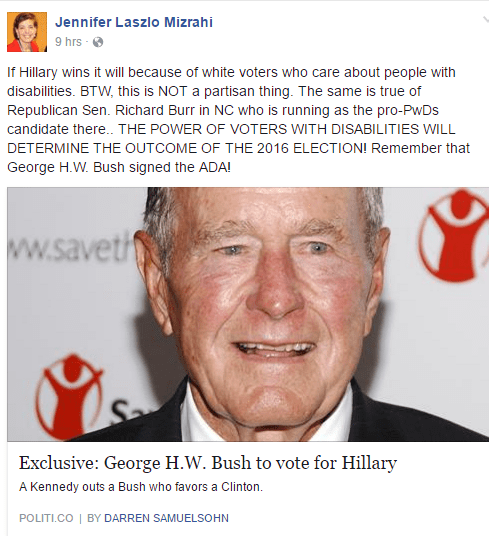
Screenshot of Mizrahi’s September 2016 Facebook post.

I’m FEDup with transactional philanthropy that presumes disrespectful behavior can be overlooked if the price is right.
I have now been witness to: RespectAbility’s President, Jennifer Laszlo Mizrahi making a mistake; the unpleased reactions by disabled women of color; some thoughtful initial responses; Mizrahi’s cringe-worthy apology-type product; the official statement; and now (I’m guessing), The Great Moving On from uncomfortable conversations about ableism, racism, and disabled people of color within the disability rights community. [2018 UPDATE: Moving on didn’t work out so great.]
Part of me — the part that’s still polite to boundary-busting missionaries who ring my doorbell — initially wanted to say, “I’ve done this kind of racist shit myself. Sadly.” Then I remembered that much of that shit was when I was near the start of my career 25 years ago. When I would have lost my job — and Bi-Pap-providing health insurance — if I kept that shit up in our very progressive free clinic for gyn care. And how I had no safety net if I lost that job.
Depending on your class, Repercussions, Consequences, & Accountability are either the Three Furies that dog you even when you haven’t screwed up, or they’re the crisis PR firm you consider for damage control.
When you’re poor, unemployed, a woman, a person of color, a disabled person, or all or most of the above, making mistakes is far more likely to lead to words like “unqualified.” You are threatened with unemployment, fired, and/or are cut off from public benefits. In the worst case scenario, you haven’t made a mistake at all but are questioned, blamed, violated, beaten, shot, killed for being the person you are in public, in school, on the road, and at home.
When you’re affluent or “comfortable,” employed, a man, white, not disabled, or all or most of the above, making mistakes is more likely to lead to words like “executive coaching,” and “Let’s bring our communications person in to help.” In the worst case scenario, you “transition out” to what is often a better-paid job, aka “failing up.” If you are in a position to be a volunteer who has significant authority, the usual checks and balances on your behavior can be even weaker.
That’s when I first realized how integral money, class privilege, and power are to this recent incident. I haven’t seen any real repercussions, consequences, or accountability for Mizrahi — except for a bump to her prestige — and that’s just one infuriating aspect of how race and class insulate those with power.
Then I reread the official statement and I hit a whole new level of disturbed.
There’s an odd segue from mentioning a nonspecific action plan to the information that Mizrahi gives to many worthy causes.
“…It takes a deliberate action plan, education and implementation.
“Outside of RespectAbility, I donate to many worthy causes….”
Translation: “Giving money is a transactional arrangement for me; it’s either outright proof that I’m a good person or at least suitable cover when my behavior is criticized as racist.”
Not even when you’ve laid claim to the word “respect” in the name of your organization. This is one place where class privilege hopes so very much to neutralize racism.
Understanding and dismantling my own race and class privilege is a lifetime of work. Being required to clean up my repeated failures was how I learned to act on — rather than merely speak of — these precepts:
Picture it: 1994-ish, the dilapidated second-floor gyn clinic, up from an iron-gated door open during clinic hours to the Upper Haight, San Francisco. A bunch of us staff are in the shabby waiting room with the furniture that will, at one point, give some of us scabies. It’s Wednesday morning, 10:30 or thereabouts, and the gate is closed because we’re having our weekly staff meeting.
 As we do every blessed week, we’re doing some kind of diversity exercise.
Everyone takes a turn, everyone complains.
Nobody gets out of it.
Everyone is deeply offended and affirmed at some point.
It was during one of those weeks that I got religion, disability-rights-wise, and that was liberating but lonely because I was the only one crip who was out. It was where I became visible to myself and then to others. But it was the example of the women of color and/or queer women who showed me how to show up. I had to follow before I could lead.
Our Director had talked our CEO into funding a 2-year Diversity Specialist consultant who will work with our whole staff. Our goal was to improve our healthcare delivery for a diverse group of women. The weeks when she is with us are rough and there are relationships that are strained and sore afterward.
We do it. We keep doing it after the funding is gone. We bake what we’ve figured out into clinic procedures, position qualifications. It’s not about us individuals, our emotional reactions, anymore. We went beyond ourselves to build a better system.
Given that Mizrahi may be Too Big To Fail, here’s my (unsolicited) action plan for RespectAbility:
Yup, that’s the plan. You’re the board. Figure out the action plan for the organization.
This is awkward necessary to say: Mizrahi is an affluent white woman executive whose manner in asking for help was that of someone Summoning The Help. The very people she had just offended. And when disabled women of color didn’t come a’runnin’, she was publicly resentful. That behavior was out of bounds.
Again:
In 2016, How To Relate To People Who Don’t Look Like You is an essential qualification for any job — paid or unpaid — in disability rights. Period. If you’re not prepared, it’s on you to get prepared.
It’s not quick or easy to truly understand intersectional oppression, nor does it make you perfect. It makes you a better imperfect person. I know because I was willing to do the work.
So. Get to work.
What would be a “threat of self-harm” for you, is a “personal choice” for me.
What calls for an intervention for you, calls for a pre-suicide party for me.
Your movie is It’s a Wonderful Life. My movie is It’s a Wonderful Death.
When it comes to people like me, suicide is rapidly becoming normalized. Or more exactly, suicide is being erased through re-branding. “It’s not ‘suicide’! It’s ‘ending your life on your own terms’!”

 Tales From the Crip
