And Now a Word From the FuckAbility™ Research Council on the Film The Favourite

If You Don’t Care for Satire, Beware of This Greek Director Filming Rabbits

The Verdict: The Favourite is full of shitty people, shitty behavior, and shit. It is a magnificent film about that most favored form of disability: crippling whilst posh. It centers a disabled woman fucking and then fucks with your head about disabled women fucking. So. It’s complex. It portrays a disabled woman being sexual and a jackhole. Also: I laughed. A lot.

(The 18th Century; The Court of Queen Anne But Not Really) If you took Tony Richardson’s Tom Jones, and Kubrick’s Dr. Strangelove, shoved them into Watership Down with any of John Waters’s pre-Hairspray films, the surviving film that hopped out might be Yorgos Lanthimos’ The Favourite.


Christ on a cracker, the FuckAbility™ Research Council hates being serious but needs must on the issue of casting and representation. Olivia Colman has a disability history that is, in fact, relevant to her role in The Favourite. Ruling that she’s not disabled enough, or has the wrong disabilities to qualify her for the role, reduces us to our diagnoses — something we have long fought against.

Bawdy without any ameliorating jolliness, The Favourite has an essential meatiness that’s mostly missing from the lives of bodies on the mainstream screen, including physically disabled, ill, or aging bodies. It got to me. The night after I watched it, I had a dream that I went to use the toilet and found I had shit smeared all under my clothes. When I woke up I knew it was because the reeking sensibility of The Favourite had made a powerful impression on me.
Continue reading

I Remember This: My Cerebral Palsy Is Cured By Muscular Dystrophy

My question seemed to make everyone relax. That made me, at 10, the person I wanted to be: In control, competent, helpful. This was difficult for them. It was a good thing for me to recognize and care about. But it was also an ability that helped me avoid feeling much of anything about the word “degenerative.”


By the time I was ten in early 1976, my father finally found a job he seemed likely to keep and we settled into our second tiny Connecticut town. I’d been to three public schools during fifth grade and was wearing the Milwaukee back-brace 23 hours a day. 
A color rendering of a large mid-century red brick building with a large rounded marquee over the entrance. It's placed on parkland.

The only picture of Newington Children’s Hospital I could find that resembles the building as I saw it in the 1970s after its renovation in 1968. This is a color rendering from eBay.

I’d started being seen in the pediatric neurology clinic at Newington Children’s Hospital, up by Hartford. (It had been formerly known by the delightful names Newington Home and Hospital for Crippled Children, as well as The Newington Home for Incurables.) Dr. Russman and Dr. Drennan, my neurologist and orthopedist, respectively, questioned my diagnosis of cerebral palsy atypical but continued the familiar routine of x-rays and exams every 3 months to monitor my always-worsening scoliosis.  
After growing the tissue from two nerve and muscle biopsies taken from my upper arm and calf (an experience that included my first overnight in a hospital, my first pre-procedure Valium, and hearing the words, “Skin stretcher, please,” uttered in connection with my own personal calf), they scheduled an appointment for the verdict. I was interested in a detached way; I was comfortable with not really being one thing or the other, medically. 

Continue reading

My FEDup™ Rant: Oh, Goody, a Debate About Whether I Should Be Allowed to Breed

FED UP TM Ideas worth ranting about


I’m FEDup with “debates” about my sexuality, my reproductive choices, my existence.  There is so much to love about social media and one of those reasons is the experience of going on Twitter to quickly check my popularity see what I can do to better the world and finding an objective discussion underway regarding whether someone like me should be “allowed” to reproduce. The person who asked the question may not even understand that, by placing my reproductive choices and existence within the frame of public approval, they’ve reinforced bias against me, a woman with a congenital disability who lives “like that.” Check out another guy who asks rational questions just like you did.


Screenshot of "Should disabled people be allowed to have children even if there is a risk of passing on a medical condition? Discuss. 1:41 AM - 21 Fed 2019


I’m not answering on Twitter because — unlike when I was in my 20s, 30s, 40’s — I no longer feel required to justify my existence just because somebody decided to have an “objective” “discussion” about whether I’m really worth the hassle.

Yup, even when your purpose is ostensibly positive, how you frame the conversation matters. Growing up with muscular dystrophy means I’ve heard more times than you can imagine that my particular disability places me — of course! — on The List of Lives That Suck. What’s newer or less personal to you is very different to me as a woman with a congenital disability. So here’s an excerpt from a longer past post that elucidates where I’m coming from. Continue reading

I Remember This: What Getting My First Milwaukee Backbrace Was Like

I don’t ordinarily post memoir pieces but I have written a lot of first-person material as writing exercises. I’m posting one such piece now to share a little bit about being a very young disabled child.

Because my memories go back to the age of three and no farther, it seems as if I came into existence as I was (just barely) walking with my mother, and occasionally my father, through the long hallways of Rochester’s Strong Memorial Hospital around 1969.
In the confusion about what was wrong with me — cerebral palsy atypical was their best guess and a misdiagnosis until I was 11 — it must have been a strange relief to the neurologists and orthopedists to come upon scoliosis, a particular problem, discrete and treatable.
Color photo of a Milwaukee back-brace.

Milwaukee back-brace used to treat scoliosis, or curvature of the spine. Photo courtesy of the Smithsonian, National Museum of American History.

Continue reading

This T-Shirt Is Real and It’s Spectacular and Tells #DisabilityDeniers That #DisabilityIsReal

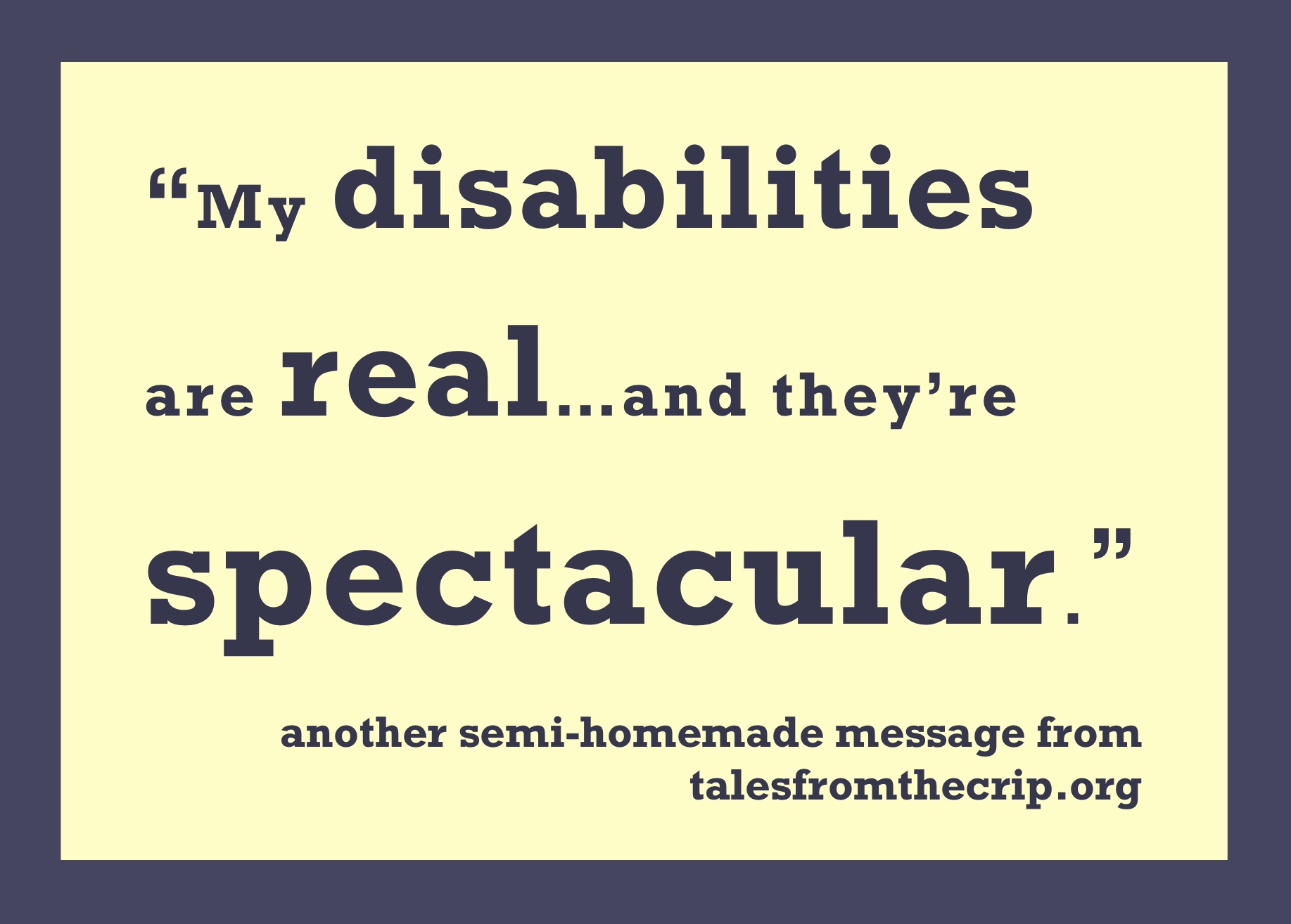
"My disabilities are real...and they're spectacular." another semi-homemade message from talesfromthecrip.orgLooking for an energy-efficient response to disability deniers? This as-seen-on-Facebook snappy comeback is now available as a t-shirt for a $25* donation to Disability Rights Education & Defense Fund (DREDF). Scroll down for details.

Continue reading