-
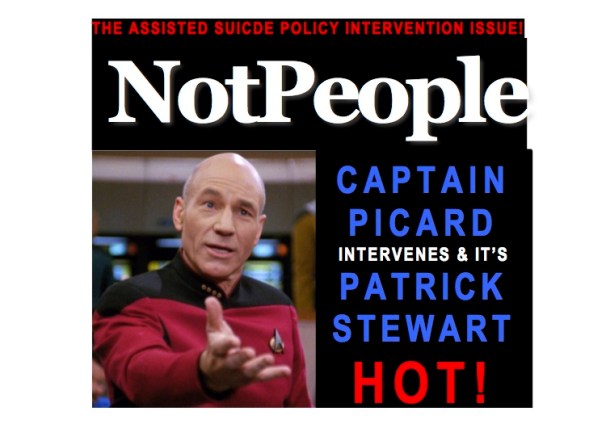 Captain’s Log: Stardate 20150808.naptime. The Enterprise is en route after refueling at Carnitas in the Al-Pastor system, but before reaching the Reflux Cluster, we’ve picked up a warning call from the Federation ship Ventilator. The decoded message tells us that a pro-assisted suicide ship, The Good Death, is in the vicinity. We’ve sent them the standard response, U-1st, but The Good Death remains as quiet as a tomb. Then it suddenly appeared on the Bridge’s screen.
 “Tell me what I’m looking at on the screen and how that man can STILL be so damnably handsome.”
Suicide, Assisted Suicide & Bioethics

Better the Rights I Know: Part 1 of Why I Oppose Assisted Suicide Legislation
All of us know that our healthcare options are limited by the boundaries set by a for-profit healthcare industry. I’m justifiably skeptical of proposed assisted suicide legislation that was written and supported by the healthcare industry. Particularly when they are marketing it as a civil right that just happens to be the $300 alternative to more costly options.
Assisted suicide legislation, modeled on Oregon’s law, is once again up for a vote in the state where I live. I look at assisted suicide legislation as a public health issue that will affect thousands of people in the state of California alone. Consider just three factors in combination:
1) California’s fastest growing demographic is people age 60 and up.
2) Elder abuse is on the rise while investigating agencies such as Adult Protective Services (APS) caseworkers are already dealing with unmanageable caseloads.
3) A physician is not required to be present when assisted suicide drugs are taken but an heir may be present and help administer them. (“Self-administer” is a term that does, in fact, allow for assistance in taking the drugs.)
This is the real-world context where proposed assisted suicide legislation would be implemented. All of us know that our healthcare options are limited by the boundaries set by a for-profit healthcare Continue reading
Ingrid’s Excellent End-of-Life-Planning Adventure
Step 1: Let’s admit our lives are not going to suddenly become unnatural as they end. Because unless you are somehow reading this from the extremely natural savanna, tundra, rainforest, permafrost region, or other isolated location where you just stumbled across web access — and thanks for finding my blog! — you’re not really all that natural right now. Unless you come from a world where dollar bills poke up out of the soil when Spring kisses the earth and visiting a private room several times a day to make an offering in the porcelain vessel is just doin’ what comes naturally, you’re no less artificial than you would be using, say, a ventilator or feeding tube.

Judging Assisted Suicide Policy, Not People
This was a tough, tough interview and the toughest question NBC asked me was: “If you were talking to Brittany Maynard right now, would you tell her she can’t have this choice?”
A: I’d say, “I don’t want you to suffer and I want you to direct your own care so you have peace of mind. I’m a woman who has a degenerative neuromuscular disease and I want that for ME. But our choices aren’t really the problem and I don’t want to be set up to judge you. But I DO have to judge proposed public policy.
Continue reading
Secrets of the Crip: Transhuman Edition
Thanks to Regan Brashear’s film FIXED, I was part of a UCSF diversity-month panel where I indoctrina — excuse me, talked to — medical students/researchers, nurses, and physical therapists about the social model of disability and my general reaction to new “human enhancements.” (As I’ve said before, I’m more old-school when it comes to enhancements — and a HUGE fan of coffee, wheelchairs, Harrington rods, BiPAPs, and orthodontics.)
Here is what I consider a key question in any discussion about human enhancements and how I answer it.
Continue reading
 Tales From the Crip