There’s No Cure for Gretchen Lowe: A Mother’s Day Card From Alice

“My daughter is a person. She’s not a chinning bar for me to build my character with. She doesn’t have cerebral palsy in order to teach me a lesson.”

There's No Cure for Gretchen Lowe

Alice’s schoolteacher handwriting greeted Gretchen in the stack of mail that evening. Oh Alice, Gretchen snorted pleasurably. I couldn’t have picked a better card myself.
A six-pack of baby angels were attempting to fly carrying a colossal banner with MOTHER written in a florid script. Droppage was imminent. Put some wing in to it, damn you. Her mother must have sent it right after Gretchen had called about the board meeting fiasco. There was a letter enclosed.
Underneath the card’s summary appreciation for maternal sacrifices, physical and emotional, Alice had written, “Thought you might like to see the enclosed item right now. I think it confirms that we are related. I cannot take credit for why you are who you are but I did have a hand in it. Then again, you were always a rotten child. Not that I had anything to do with that. Love, Mom.
The letter was her mother’s same handwriting.  Cheered, Gretchen set to reading it. It was dated from May 1970 and addressed to a Desmond Wallace, Chair of Fundraising Operations for the National Cerebral Palsy Association. Oh dear. Continue reading

Mr Ableism Proposes to Dispose of Miss Cripple Using the Sarco Death Pod


deathstyles of the rich & abled, MALE-PATTERN BS, REGENCY CRIP LIT

It is a truth universally acknowledged that a woman in possession of a neurodegenerative disease must be in want of an early death.

My dear Miss Cripple,
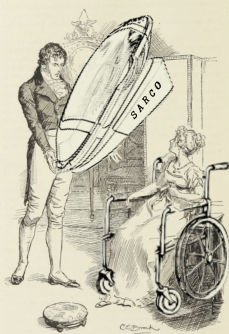
Illustration from Pride and aPrejudice with a standing Mr. Darcy and a seated Lizzie. Illustration now has Mr. Darcy offering a Sarco Death Pod and Lizzy sitting in a manual wheelchair,

Mr Abled’s proposal so enraged her that she could only reply, “You first, sir” when he presented her with a  Sarco Death Pod of betrothal.

Madam, in vain I have struggled. It will not do. My feelings will not be repressed. You must allow me to tell you how ardently I pity you and plead you to accept my assistance  in hastening your death using the Sarco Death Pod on its Delicates & Gentlewomen setting.

In declaring myself thus, I am fully aware that I will be going expressly against the notion of a healthcare system that prioritizes people over profit, the rights of  many people with disabilities, and, I hardly need add, my own better judgment.

But, as you may have heard, “civil rights” for unfortunates such as yourself are now largely reserved for your demise.  Particularly when a gentleman such as your father has five daughters and only a small income. How may such as he afford to see your sisters wed if you and your costly care refuse to be dead? Continue reading

I Want Them to Want Me Because I Will Need Them to Need Me But If That’s Not Going to Work, I Want a Lawyer.

There's No Cure for Gretchen Lowe

Every time Gretchen saw the DNR forms on her desk at home, a wave of resentment rose. How did she know what it was like to use a feeding tube? Or a ventilator? Or have minimal brain function, for god’s sake? It was like asking an eight year-old to sign up for – or against – puberty.
Choice was such bullshit. It wasn’t really her choice at all. The problem wasn’t too much extraordinary medical treatment, it was the limits of ordinary medicine to worry about, mostly financial. She didn’t have a problem being kept alive through artificial means now – she’d never seen a dollar bill push out of the dirt in spring – so she didn’t see any reason to assume she would resent it later on.

“Dear Valued Healthcare Provider,

“I’m glad everybody’s so concerned about honoring my choices. I choose to have my medical care continue regardless of ability to pay or insurance coverage, deductibles, prescription benefits, or other cost issues….”


Continue reading

I Remember This: I See a Disabled Person

Cartoonized image of Ingrid Tischer's eyes in close-up.I remember this:

I am eight. I am waiting alone for the little bus inside the doors of my school, White Sulphur Springs Elementary, in the Catskills. I glimpse a small girl not  far away – tired, leaning against the wall like it was holding her up. Seeing her, I feel a sorrow for her. The sorrow is bigger than me, it blooms out of my stomach and swallows me whole like a monstrous flower.  In the next instant, I see that I’m looking at myself in the reflection of a display cabinet’s glass doors. I am angry at myself – first, for letting myself look like that  – then, for looking like that. Then I know that I will never be faster than seeing is. It can get even me. This means that while I’ll empathize with strangers who feel sorry for me in decades to come – having done it myself – I’ll want them to snap out of it, too – as I did.

I’ve been the only (identified) disabled student in my classes in five schools since first grade, I see children “like me” at this clinic and on tv once a year during a telethon that makes me cringe. That’s it. I have a pronounced lack of images to work with and an inability to decipher the ones I do see.


Continue reading

I Remember This: I Am Thirteen and in the Recovery Room After Spinal Fusion Surgery

Cover of Mythology by Edith HamiltonYou are flat on your back under a glaring light. The bed is hard. It hurts. You don’t move because it doesn’t occur to you to do so, it’s so far beyond you. Each part of you that registers – reports in, so to speak – registers through pain. You body is mapped as a topography of pain. No face or distinguishing characteristics. You are a ground-colored shape dotted with points of glaring, popping pain. Where your head aches on the stone-stab mattress, where the gravel of the sheet is under your arms, where it rasps all along the tube that snakes down your throat, to an unidentifiable pressure on your front, low down.
Your back. Oh. Your back is a barely contained thorn patch in a mad stabber’s arsenal.
You’re not alone. There are voices, professional ones. But no one is talking to you.
There is a nurse above you, meeting your eyes. Her head blocks the light. “You’re awake,” she says. “You’re in the recovery room.”
You make a sound. It sounds dreadful. The first sound Frankenstein made on his slab. The thought of the monster brings back your past, all there was before this light, this slab, this pain. And the face in your reunion with memory itself is: Gene Wilder in Young Frankenstein.
Continue reading