scoliosis

I Remember This: My Cerebral Palsy Is Cured By Muscular Dystrophy
My question seemed to make everyone relax. That made me, at 10, the person I wanted to be: In control, competent, helpful. This was difficult for them. It was a good thing for me to recognize and care about. But it was also an ability that helped me avoid feeling much of anything about the word “degenerative.”
By the time I was ten in early 1976, my father finally found a job he seemed likely to keep and we settled into our second tiny Connecticut town. I’d been to three public schools during fifth grade and was wearing the Milwaukee back-brace 23 hours a day.

The only picture of Newington Children’s Hospital I could find that resembles the building as I saw it in the 1970s after its renovation in 1968. This is a color rendering from eBay.
I’d started being seen in the pediatric neurology clinic at Newington Children’s Hospital, up by Hartford. (It had been formerly known by the delightful names Newington Home and Hospital for Crippled Children, as well as The Newington Home for Incurables.) Dr. Russman and Dr. Drennan, my neurologist and orthopedist, respectively, questioned my diagnosis of cerebral palsy atypical but continued the familiar routine of x-rays and exams every 3 months to monitor my always-worsening scoliosis.
After growing the tissue from two nerve and muscle biopsies taken from my upper arm and calf (an experience that included my first overnight in a hospital, my first pre-procedure Valium, and hearing the words, “Skin stretcher, please,” uttered in connection with my own personal calf), they scheduled an appointment for the verdict. I was interested in a detached way; I was comfortable with not really being one thing or the other, medically.
I Remember This: What Getting My First Milwaukee Backbrace Was Like
I don’t ordinarily post memoir pieces but I have written a lot of first-person material as writing exercises. I’m posting one such piece now to share a little bit about being a very young disabled child.
Because my memories go back to the age of three and no farther, it seems as if I came into existence as I was (just barely) walking with my mother, and occasionally my father, through the long hallways of Rochester’s Strong Memorial Hospital around 1969.
In the confusion about what was wrong with me — cerebral palsy atypical was their best guess and a misdiagnosis until I was 11 — it must have been a strange relief to the neurologists and orthopedists to come upon scoliosis, a particular problem, discrete and treatable.

Milwaukee back-brace used to treat scoliosis, or curvature of the spine. Photo courtesy of the Smithsonian, National Museum of American History.
#CripLit Chapter 2: Funktionslust
 There was no way Alice had fit all that into one suitcase. Gretchen accepted the coffee but waved off questions about her sore throat. She rocked thoughtfully as Alice fretted about her being too ill for the clinic visit later in the day. “Mom? You’re looming.”

My Speech to the Graduates, or What I Wish I’d Known As a 5 Year-Old Crip
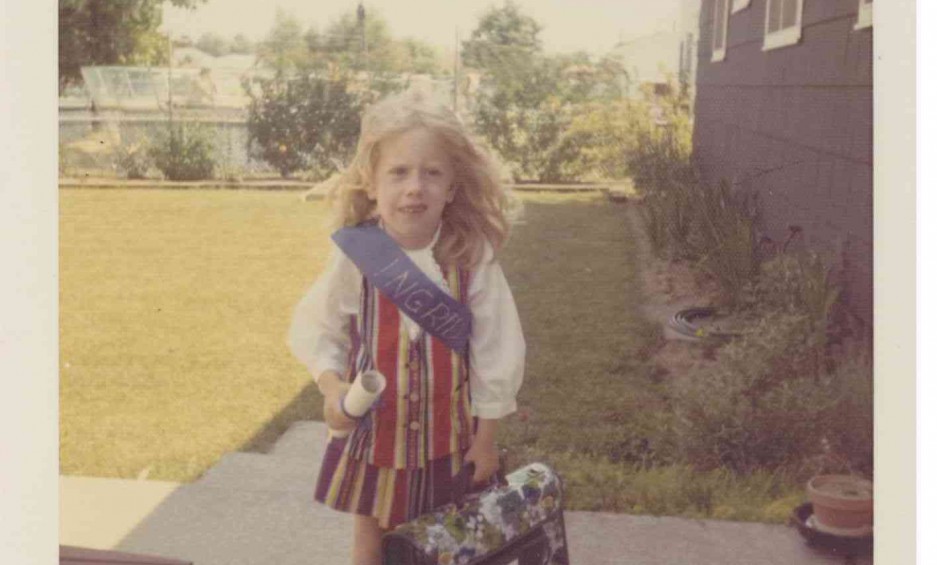
Ingrid Tischer on the day of her kindergarten graduation in Greece, New York, circa 1970. She is wearing a rainbow vest and skirt sewn by her mom. Note the clutching of the diploma and school-bestowed book-bag, and anxious expression — all indicate a future in literary fiction writing and nonprofit fundraising.
If the grand success of the 20th century was the rise of disability as an accepted political identity, we intend for the 21st century to be the time when disability is recognized as the constant but hidden variable in nearly all formulas for global human rights.
Including disability as a given factor in most people’s lives is essential to successfully advancing the human rights of people in minority communities; survivors of violence in the home, the school, and the street, and/or conflict zones, and as veterans; immigrant and refugees held in detention, incarcerated people, people coerced into institutionalization; people who live with chronic and catastrophic illness; neuro-diverse people; people who are young and old; male, female, and everywhere on the gender spectrum.
While disability has been understood as “different and divided” I believe it can come to be seen as “unique and united.”
As you sit sweating under an increasingly sweltering sun this day, feeling the inevitable effects of a wasteful attitude toward natural resources, you may not be thinking of another type of catastrophic loss caused by another type of massive denial. I speak of almost no one’s favorite topic: Disability.
How denying disability’s central role in just about every human life relegates significant chunks of our lives — and worse still, people-sized chunks — to the rubbish heap. It may be that “disabled” doesn’t feel like a word that fits who you are. Fine. Have you ever felt vulnerable? Think of “vulnerable” as a gateway word to a chronic case of disability-speak.
 Tales From the Crip