girls with disabilities

I Remember This: The Girls With the Black Bars Over Their Faces
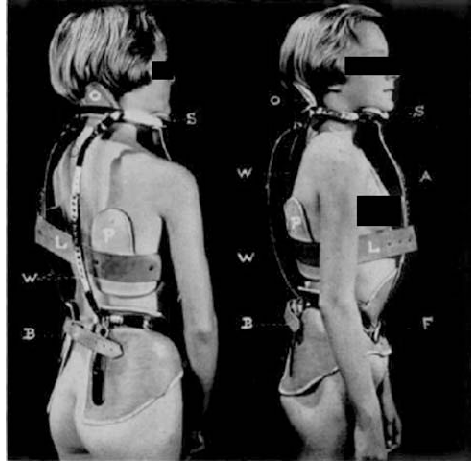
Source: researchgate.net: (Reprinted from Blount WP, Schmidt AC, Bidwell RG. Making the Milwaukee brace. J Bone Joint Surg Am. 1958;40:526–528 with permission from Journal of Bone and Joint Surgery, Inc., Needham, MA.)
1977. I am 11 years old. I am half-naked in a crowded hospital hallway.
I’ve gotten ten steps down the hall from the exam room where my mother is waiting before I fully appreciate that my fish-white thighs are fully on display.
My thighs are doing their best to walk the rest of me onward. The rest of me is wearing underpants, an all-too-sheer white t-shirt, and a Milwaukee back-brace.
The words, You are half-naked in public, explode in my mind like a bad-dream bomb.
Continue reading
I Remember This: I See a Disabled Person
 I remember this:

I am eight. I am waiting alone for the little bus inside the doors of my school, White Sulphur Springs Elementary, in the Catskills. I glimpse a small girl not far away – tired, leaning against the wall like it was holding her up. Seeing her, I feel a sorrow for her. The sorrow is bigger than me, it blooms out of my stomach and swallows me whole like a monstrous flower. In the next instant, I see that I’m looking at myself in the reflection of a display cabinet’s glass doors. I am angry at myself – first, for letting myself look like that – then, for looking like that. Then I know that I will never be faster than seeing is. It can get even me. This means that while I’ll empathize with strangers who feel sorry for me in decades to come – having done it myself – I’ll want them to snap out of it, too – as I did.
I’ve been the only (identified) disabled student in my classes in five schools since first grade, I see children “like me” at this clinic and on tv once a year during a telethon that makes me cringe. That’s it. I have a pronounced lack of images to work with and an inability to decipher the ones I do see.
I Remember This: I Am Thirteen and in the Recovery Room After Spinal Fusion Surgery
 You are flat on your back under a glaring light. The bed is hard. It hurts. You don’t move because it doesn’t occur to you to do so, it’s so far beyond you. Each part of you that registers – reports in, so to speak – registers through pain. You body is mapped as a topography of pain. No face or distinguishing characteristics. You are a ground-colored shape dotted with points of glaring, popping pain. Where your head aches on the stone-stab mattress, where the gravel of the sheet is under your arms, where it rasps all along the tube that snakes down your throat, to an unidentifiable pressure on your front, low down.

Your back. Oh. Your back is a barely contained thorn patch in a mad stabber’s arsenal.
You’re not alone. There are voices, professional ones. But no one is talking to you.
There is a nurse above you, meeting your eyes. Her head blocks the light. “You’re awake,” she says. “You’re in the recovery room.”
You make a sound. It sounds dreadful. The first sound Frankenstein made on his slab. The thought of the monster brings back your past, all there was before this light, this slab, this pain. And the face in your reunion with memory itself is: Gene Wilder in Young Frankenstein.
Continue reading
I Remember This: My Cerebral Palsy Is Cured By Muscular Dystrophy
My question seemed to make everyone relax. That made me, at 10, the person I wanted to be: In control, competent, helpful. This was difficult for them. It was a good thing for me to recognize and care about. But it was also an ability that helped me avoid feeling much of anything about the word “degenerative.”
By the time I was ten in early 1976, my father finally found a job he seemed likely to keep and we settled into our second tiny Connecticut town. I’d been to three public schools during fifth grade and was wearing the Milwaukee back-brace 23 hours a day.

The only picture of Newington Children’s Hospital I could find that resembles the building as I saw it in the 1970s after its renovation in 1968. This is a color rendering from eBay.
 Tales From the Crip