Genetically defective

#CripLit Chapter 2: Funktionslust
 There was no way Alice had fit all that into one suitcase. Gretchen accepted the coffee but waved off questions about her sore throat. She rocked thoughtfully as Alice fretted about her being too ill for the clinic visit later in the day. “Mom? You’re looming.”

Before I Resist and Persist, I Must Exist: Bioethical Choice, Living “Like That,” and Working the Early Shift of Cleaning Up Ableist Narratives
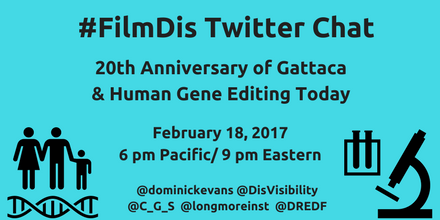 I represented DREDF in this conversation but it’s stirred up a big case of the feels about “choice” and being a liberal woman writer with a congenital disability, and the context this establishes for storytelling, and resisting and persisting. I continue, after 30 years of adult activism, to feel like I have an early shift of ableism — prepping the world to accept that I exist — while my nondisabled fellow human resisters and persisters get to sleep in. And if I weren’t white, conventionally educated, cis gendered, unthreateningly queer, and had all sorts of middle-class, married advantages, I’d probably never sleep at all. Image courtesy of the Disability Visibility Project.

Step 1: I Exist!
As many people who know me know — all too well — I’ve been writing a novel* for the past 400 years or so. The novel, The Cure for Gretchen Lowe, is the exploration of a what-if premise: What if a congenitally disabled woman were offered an experimental therapy that would cure her? The cure itself, Genetic Reparative Therapy (GRT), was never the point of the story because biomedical research, real or invented, never seemed like the most interesting part of the story. What I’ve been stuck on, like an oyster (or barnacle), since the idea first irritated my imagination was how I saw that my character’s situation began as a will-she-or-won’t-she question. From what I’ve observed in 50+ years of congenitally disabled life, that question isn’t typically a question to The Average Reader. “Well, of course a person like that would want GRT!”
I’ve considered that point of view quite a bit — 400 years allows for that — and much more seriously than I make it sound here. But that assumption also irritated me mightily: As a lifelong like-that-ter, I’ve run up against a lot of nonconsensual of-coursing when it comes to my bioethical choices. Simply opening my story — which I refer to as being “CripLit” — with a genuine choice, not a pro forma one, felt like I wrote in letters across the sky: I EXIST.
Depression and Suicide Do Not Come Standard With the Progressive Disability Package
A few weeks ago, Alice Wong asked me, a fellow person living with a progressive neuromuscular disease (NMD), how I would respond to someone with an NMD who was saying they wanted to commit suicide. This was my answer.
Depression is not a standard feature of living with a neuromuscular disease (NMD) or other progressive disability.
Do people living with disabilities also experience depression? Yes. Anyone can have depression and you are no different in deserving treatment and relief for it. Thinking that you alone can help yourself with your depression through suicide is a tragic form of “overcoming.”
If finding the right treatment for your depression proves difficult, it’s not proof that your disability makes you different from other people.
It’s not proof that, for you, suicide is a rational choice. No. It’s proof that depression is difficult to treat for vast numbers of people. Like you.
It’s free and confidential to contact the National Suicide Prevention Lifeline anytime. You are not a medical prognosis or a checklist of functional abilities. You’re a person. Who is in terrible pain now and deserves relief.
If you’re in crisis:
1-800-273-TALK (8255) , 1-800-799-4TTY (4889)
@800273TALK
 Tales From the Crip