Before I Resist and Persist, I Must Exist: Bioethical Choice, Living “Like That,” and Working the Early Shift of Cleaning Up Ableist Narratives

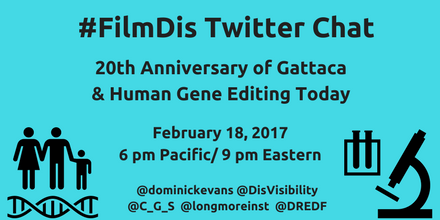
filmdis-feb-18-1I represented DREDF in this conversation but it’s stirred up a big case of the feels about “choice” and being a liberal woman writer with a congenital disability, and the context this establishes for storytelling, and resisting and persisting. I continue, after 30 years of adult activism, to feel like I have an  early shift of ableism — prepping the world to accept that I exist — while my nondisabled fellow human resisters and persisters get to sleep in.  And if I weren’t white, conventionally educated, cis gendered, unthreateningly queer, and had all sorts of middle-class, married advantages, I’d probably never sleep at all. Image courtesy of the Disability Visibility Project.

 Step 1: I Exist!

As many people who know me know — all too well — I’ve been writing a novel* for the past 400 years or so. The novel, The Cure for Gretchen Lowe, is the exploration of a what-if premise: What if a congenitally disabled woman were offered an experimental therapy that would cure her? The cure itself, Genetic Reparative Therapy (GRT), was never the point of the story because biomedical research, real or invented, never seemed like the most interesting part of the story. What I’ve been stuck on, like an oyster (or barnacle), since the idea first irritated my imagination was how I saw that my character’s situation began as a will-she-or-won’t-she question. From what I’ve observed in 50+ years of congenitally disabled life, that question isn’t typically a question to The Average Reader. “Well, of course a person like that would want GRT!”

I’ve considered that point of view quite a bit — 400 years allows for that — and much more seriously than I make it sound here. But that assumption also irritated me mightily: As a lifelong like-that-ter, I’ve run up against a lot of nonconsensual of-coursing when it comes to my bioethical choices. Simply opening my story — which I refer to as being “CripLit” —  with a genuine choice, not a pro forma one, felt like I wrote in letters across the sky: I EXIST.

Continue reading

#WSPD2016: Suicide Is a Problem, Not a Solution for Living With a Disability. Yup, Even One That’s Neuromuscular, Progressive, and Degenerative

September 10 is World Suicide Prevention Day. But for a disabled person like me,  it’s just not my day.

Increasingly:

What would be a “threat of self-harm” for you, is a “personal choice” for me.

What calls for an intervention for you, calls for a pre-suicide party for me.

Your movie is It’s a Wonderful Life. My movie is It’s a Wonderful Death.

When it comes to people like me, suicide is rapidly becoming normalized. Or more exactly, suicide is being erased through re-branding. “It’s not ‘suicide’! It’s ‘ending your life on your own terms’!”

But I want a great pre-end of life. I want to live on my own terms.Ingrid posing with her Respironics Bi-Pap S/T

Continue reading

HEY! YOU! MEDIA!: Let’s Make Suicide Awareness Month and World Suicide Prevention Day Inclusive of People With Disabilities

5.  Why is suicide being presented as a solution, rather than a problem, when the people involved have disabilities?

September is Suicide Awareness Month and September 10 is World Suicide Prevention Day. I’m writing this because media coverage over the past year alone seems to warrant an explicit reminder that:

  • We don’t lack awareness of people with disabilities committing suicide; we do allow vulnerable people to feel shame over chronic pain and depression.
  • Our suicides deserve prevention, not encouragement and cultural misrepresentation, as in films such as Me Before You.

What’s the context beyond the medical? What are the underlying attitudes guiding how the media’s coverage of people with disabilities who have committed suicide or who are planning to do so?

Continue reading

Depression and Suicide Do Not Come Standard With the Progressive Disability Package

A few weeks ago, Alice Wong asked me, a fellow person living with a progressive neuromuscular disease (NMD), how I would respond to someone with an NMD who was saying they wanted to commit suicide.  This was my answer.

Depression is not a standard feature of living with a neuromuscular disease (NMD) or other progressive disability.Depression & Suicide Do Not Come Standard With the Progressive Disability Package Depression is not a standard feature of living with a neuromuscular disease (NMD) or other progressive disability. Do people living with disabilities also experience depression? Yes. Anyone can have depression and you are no different in deserving treatment and relief for it. Thinking that you alone can help yourself with your depression through suicide is a tragic form of “overcoming.” If finding the right treatment for your depression proves difficult, it’s not proof that your disability makes you different from other people. It’s not proof that, for you, suicide is a rational choice. No. It’s proof that depression is difficult to treat for vast numbers of people. Like you. It's free and confidential to contact the National Suicide Prevention Lifeline anytime. You are not a medical prognosis or a checklist of functional abilities. You're a person. Who is in terrible pain now and deserves relief. Like everybody else. If you're in crisis: 1-800-273-TALK (8255), 1-800-799-4TTY (4889) https://www.facebook.com/800273talk/ @800273TALK © 2016 talesfromthecripblog.com

Do people living with disabilities also experience depression? Yes. Anyone can have depression and you are no different in deserving treatment and relief for it. Thinking that you alone can help yourself with your depression through suicide is a tragic form of “overcoming.

If finding the right treatment for your depression proves difficult, it’s not proof that your disability makes you different from other people.

It’s not proof that, for you, suicide is a rational choice. No. It’s proof that depression is difficult to treat for vast numbers of people. Like you.

It’s free and confidential to contact the National Suicide Prevention Lifeline anytime. You are not a medical prognosis or a checklist of functional abilities. You’re a person. Who is in terrible pain now and deserves relief.

If you’re in crisis:

1-800-273-TALK (8255) , 1-800-799-4TTY (4889)
@800273TALK
 

Announcing #ADA26 as The Year of #SassingBack, #CripLit-Style


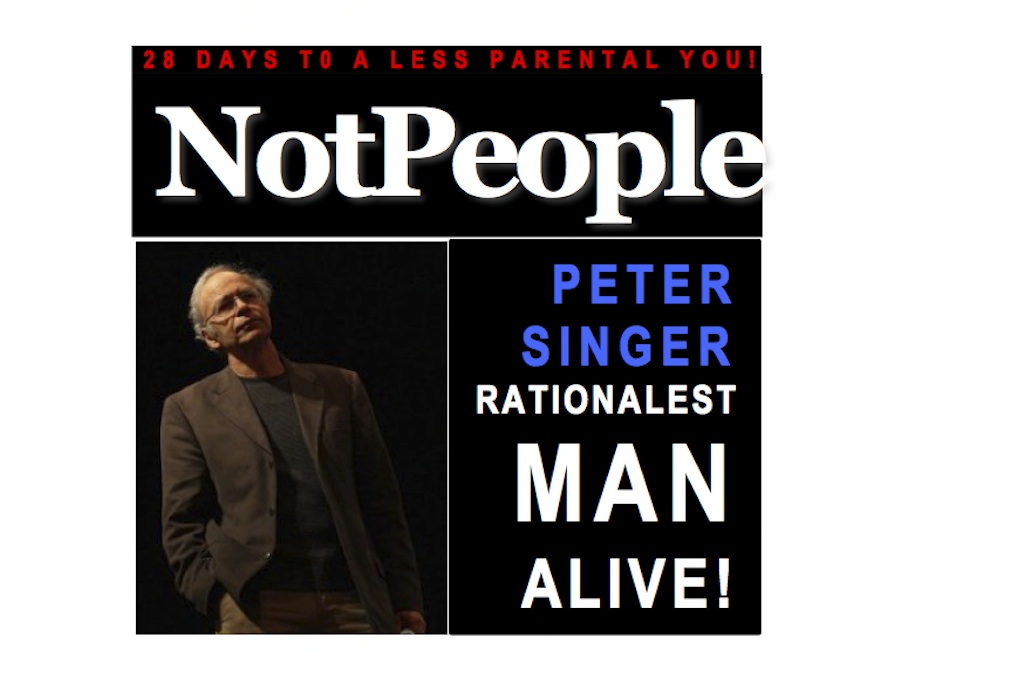
Parody People magazine cover announcing NotPeople's Rationalest Man Alive! Peter Singer

Unlike Melania Trump, Tales From the Crip plagiarizes only its own material. In honor of the Americans with Disabilities Act’s 26th anniversary, TFtC is kicking off The Year of Sassing Back, #CripLit-Style by offering this gently-used excerpt from our first — and only! — NotPeople Magazine’s Imaginary Interviews With People Who We Wish Were Imaginary. Our own Respironics Bi-Pap S/T sat down with philosopher Dr. Peter Singer, Princeton’s Ira W. DeCamp Professor of Bioethics, whose anti-crip, pro-swine agenda argues that infanticide of babies with disabilities should be legal up until the 28th day after birth, that health care for people with disabilities should be rationed, and that the consciousness of some pigs doesn’t get enough respect. Happy ADA26! We’re not dead yet!

On the Love Secrets of the Utilitarian!

RBPS/T: Isn’t “No Rules, Just Rights” pretty much the mating call of the utilitarian?

PS: “If it feels good, do it,” is a much more rational mating call.

RBPS/T: What’s a common way for a utilitarian to get friend-zoned?

PS: A utilitarian could help a hot girl move and then she gets back together with her bass-player ex. Who’s a contemporary Continental phenomenologist.

RBPS/T: That sounds…nonhypothetical. And gender-biased. But hey, you are a philosopher.

PS: JUST BECAUSE WE’RE UTILITARIANS DOESN’T MEAN WE LIKE BEING USED.

RBPS/T: Hypothetically.

PS: It was a long time ago. I am completely and 110% over it. My happiness has never been more maximized. A random person might see me on this cover and think, “Wow, he is totally living the life he said he would and here I am, possibly married to but probably long-since-dumped by an untalented string player who distracted me from what my life could have been, and if something tragic happens like I get so horribly disfigured in an accident that I need expensive but ultimately futile treatments or I have an adorable but super sick baby — which wouldn’t be so unlikely if the weak genes of a contemporary Continental phenomenologist were involved in the uterine brew — I will most definitely not want societal resources wasted on prolonging our now-useless lives that are almost entirely composed of suffering moments that don’t include one single glimpse much less the infinitely tender touch of the brilliant moral pragmatist — pragmatic moralist? — I should have appreciated and who I secretly dream of providing me with his personal care and support at no cost to the public or to his individual liberty.” SHOW ME ONE TENURED “ARTIST,” SHEILA!

RBPS/T: No projection there.

PS: What’s projection?