#LiveBoldly on 6/2! Join Growing Wave of Protest Against Euthanasia Rom-Com “Me Before You” in Berkeley, CA

ACTION ALERT: DISABILITY SNUFF FILM “ME BEFORE YOU” PROTEST

WHEN: June 2, 2016, 6:15PM-7:15PM PT

WHERE: Shattuck Cinemas, 2230 Shattuck Ave (at Kittredge), Berkeley, California 94704

WHAT: Peaceful demonstration and leafletting

WHY: To oppose the film’s ableist message that people with disabilities are better off dead and that we are a burden to others

“Me Before You” is the latest Hollywood film to grossly misrepresent the lived experience of the majority of disabled people. In the film, a young, white, and wealthy man becomes disabled and falls in love with his “carer” who has been hired by his family to cure his suicidal depression with romance.

Despite her opposition, however, the hero does the “honorable” thing by killing himself at the Swiss euthanasia clinic Dignitas – leaving his fortune to her so she can move on without the “burden” of a disabled partner. Based on the best-selling novel of the same name, “Me Before You” is little more than a disability snuff film, giving audiences the message that if you’re a disabled person, you’re better off dead.

For more information, see the following articles:

Spare me, “Me Before You”: Hollywood’s new tearjerker is built on tired and damaging disability stereotypes
Why Some Disability Rights Activists Are Protesting ‘Me Before You”
People Are Annoyed About How “Me Before You” Represents Disability
Hollywood Promotes the Idea It Is Better To Be Dead Than Disabled
A Second Class Existence: Me Before You Gets It All Wrong
Why Are You Complaining? Some People Actually Feel That Way: A Critique of Me Before You

And Now a Word From the FuckAbilityTM Research Council on the Film “Me Before You”

BONUS UPDATE ACTION ALERT!
From the FuckAbility™ Research Council:
“In response to movie theaters handing out Kleenex to ‘Me Before You’ ticket buyers, FARC calls on our sacrificial viewers to proceed to theaters carrying rolls of toilet paper. When offered the Kleenex, counter-offer your TP, and explain, ‘You’re gonna need it – Me Before You is full of ableist shit.”
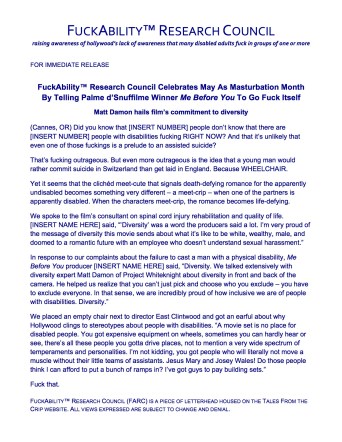
FuckAbility™ Research Council Celebrates May As Masturbation Month By Telling Palme d’Snuffilme Winner Me Before You To Go Fuck Itself

Matt Damon hails film’s commitment to diversity

(Cannes’t, OR) Did you know that [INSERT NUMBER] people don’t know that there are [INSERT NUMBER] people with disabilities fucking RIGHT NOW? And that it’s unlikely that even one of those fuckings is a prelude to an assisted suicide?

That’s fucking outrageous. But even more outrageous is the idea that a young man would rather commit suicide in Switzerland than get laid in England. Because WHEELCHAIR.

“He helped us realize that you can’t just pick and choose who you exclude – you have to exclude everyone. In that sense, we are incredibly proud of how inclusive we are of people with disabilities.”

Yet it seems that the clichéd meet-cute that signals death-defying romance for the apparently undisabled becomes something very different – a meet-crip – when one of FuckAbility™ Research Councilthe partners is apparently disabled.

When the characters meet-crip, the romance becomes life-defying.

We spoke to the film’s Medical Advisor, [INSERT NAME HERE], on the movie’s messages about spinal cord injury rehabilitation and quality of life. “’Diversity’ was a word the producers said a lot. I’m very proud of the message of diversity this movie sends about what it’s like to be white, wealthy, male, and doomed to a romantic future with an employee who doesn’t understand sexual harassment.”
Continue reading

The Top 10 Reasons Why Medically Stunting the Growth of Girls With Severe Disabilities Continues To Be an Ethical and Well-Thought-Out Solution To the Problem of Financially Stunting Public Funding for In-Home Social Services, Which Is…Huh, How ‘Bout That.

5. Because we need to support the decisions of overburdened parents/caregivers of severely disabled children right up until the time when their decisions require public funding for adequate and affordable in-home supports.

It’s feels like it’s 2007 all over again, what with “growth-attenuation therapy” for severely disabled children – many of whom are girls – being back in the news.  And today, just like then, people with disabilities are trying to make this all about them. But there’s no unrecognized ableism framing this “ethical debate.” It’s not as though fearful parents who really do care about their children — who really are severely disabled — are being given an absurd and brutal choice:

Continue reading

Thank You, Two-Thirds of the Planet…

…for sharing “My Speech to the Graduates or What I Wish I’d Known As a 5-Year Old Crip.” It was an honor to be reblogged by you!

What do you want to contribute to that is bigger than yourself? What is it that you have to contribute?

These questions may sound like the trite stuff of a book whose central mystery is the length of its run on the best-seller list. But they matter to me because — again, as the little girl with a disability — what I heard gently murmuring in the cultural wind was: “That’s okay, don’t worry about contributing to us (the world). You’ve got enough to deal with.” Those things I care about? The writing sentences? The fairness? (Forget being President, that’s not the point.) I cared enough to know I didn’t want to be gently excused from ambition, from life, from the world’s business.

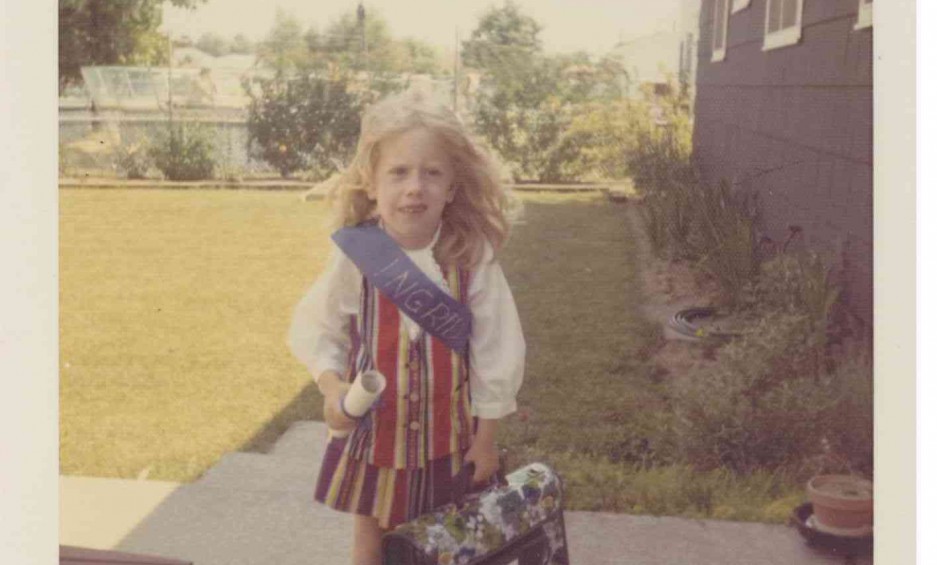
Ingrid Tischer on the day of her kindergarten graduation in Greece, New York, circa 1969. She is wearing a rainbow vest and skirt sown by her mom. Note the clutching of the diploma and school-bestowed book-bag, and anxious expression -- all indicate a future in literary fiction writing and nonprofit fundraising.

Ingrid Tischer on the day of her kindergarten graduation in Greece, New York, circa 1970. She is wearing a rainbow vest and skirt sown by her mom. Note the clutching of the diploma and school-bestowed book-bag, and anxious expression — all indicate a future in literary fiction writing and nonprofit fundraising.

2016 Ramp-up to the White House: 5 Questions for the Democratic Candidates for Crip-in-Chief

“If Lincoln and FDR were hanging out with a bunch of crips and you wanted to join them, what would you bring to the disability table?”

While voting access will continue to be a disability rights issue,  here are key questions that address your readiness to be Crip-in-Chief. Please note that any answer in the form of inspiration porn will immediately disqualify you.

Question #1:  It’s 3AM in the White House (as it is everywhere in that time zone). The phone rings.  It’s Sylvia Burwell, the head of DHHS that oversees the Centers for Medicare and Medicaid Services (CMS). CMS is STILL sending printed forms to blind consumers and crips are not just pissed but suing. Explain how you get that this is emblematic of being a person with a disability: Most people think disability = sick = great healthcare access when it does not. Then explain your civil rights approach to such structural disability discrimination, how you will engage cross-disability advocates, and how your Obamacare/single-payer system will prevent such debacles.

Question #2:  Human worth in our country has long been measured by participation in the paid workforce. How will you promote a culture of respect backed by legal protections  for people who are unlikely to join or rejoin the paid workforce — a vast coalition that includes some adults who identify as “disabled;” adults with chronic health conditions, survivors of trauma, violence, and conflict zones;  many older people and veterans, parents (particularly mothers); and all (we hope) children.

Question #3:  Young people with disabilities today are being told that they should expect to find be a paying job. This is great — sort of.  Their success is presented as being fundamentally a matter of overcoming their own attitudes and disabilities. But many — particularly youth of color — are systematically denied an education and shoved into the school-to-prison pipeline. How are you going to dismantle the infrastructural  and intersectional barriers to employment that persist: lack of access to education,  housing, transportation, in-home supports? How will you shift the country from a “special needs” lens to an “equal rights” lens?

Question #4:  Explain how, as a pro-choice candidate, you would ensure women with disabilities and all queer people with disabilities (quips!) truly have choices with regard to their own sexual agency, pregnancy, parenting, and custody disputes. And how would you address the implicit ableism that frequently presents the decision to bear and parent a child with a disability as a cost-benefit analysis — and a rigged one, at that?

Question #5:  In a time of economic inequality, lost faith in a for-profit healthcare industry, and increasing elder abuse, assisted suicide legislation is gaining ground as a personal liberty rather than a public health issue.  Again, this is a question about policy  and medical standards of care affecting millions of diverse people, not an individual belief system. Do you support laws that indemnify physicians who prescribe lethal drugs but don’t require any medical provider or trained personnel to monitor, attend, follow-up if/when the consumer uses them?

Bonus Question: Two transformative presidents, Lincoln and FDR, lived with disabilities. Like many Americans today, neither identified as “disabled,” but their respective Administrations nevertheless reflected a deep understanding of another term for “disabled”: “vulnerable.” If Lincoln and FDR were hanging out with a bunch of crips and you wanted to join them, what would you bring to the disability table?

Remember: Our civil rights matter and so do our votes!