Announcing #ADA26 as The Year of #SassingBack, #CripLit-Style


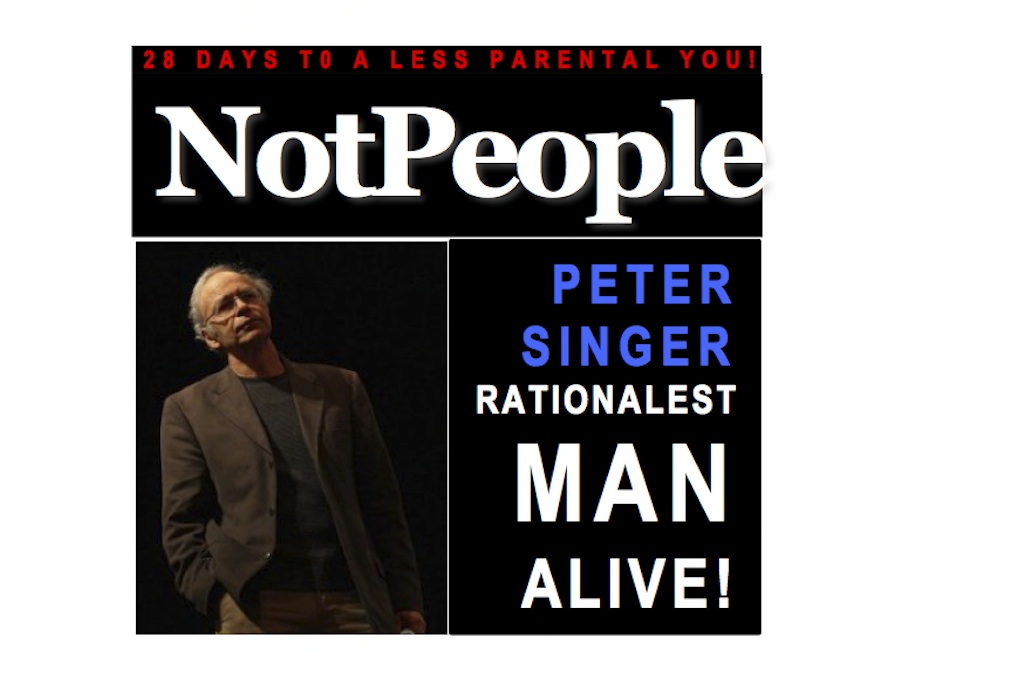
Parody People magazine cover announcing NotPeople's Rationalest Man Alive! Peter Singer

Unlike Melania Trump, Tales From the Crip plagiarizes only its own material. In honor of the Americans with Disabilities Act’s 26th anniversary, TFtC is kicking off The Year of Sassing Back, #CripLit-Style by offering this gently-used excerpt from our first — and only! — NotPeople Magazine’s Imaginary Interviews With People Who We Wish Were Imaginary. Our own Respironics Bi-Pap S/T sat down with philosopher Dr. Peter Singer, Princeton’s Ira W. DeCamp Professor of Bioethics, whose anti-crip, pro-swine agenda argues that infanticide of babies with disabilities should be legal up until the 28th day after birth, that health care for people with disabilities should be rationed, and that the consciousness of some pigs doesn’t get enough respect. Happy ADA26! We’re not dead yet!

On the Love Secrets of the Utilitarian!

RBPS/T: Isn’t “No Rules, Just Rights” pretty much the mating call of the utilitarian?

PS: “If it feels good, do it,” is a much more rational mating call.

RBPS/T: What’s a common way for a utilitarian to get friend-zoned?

PS: A utilitarian could help a hot girl move and then she gets back together with her bass-player ex. Who’s a contemporary Continental phenomenologist.

RBPS/T: That sounds…nonhypothetical. And gender-biased. But hey, you are a philosopher.

PS: JUST BECAUSE WE’RE UTILITARIANS DOESN’T MEAN WE LIKE BEING USED.

RBPS/T: Hypothetically.

PS: It was a long time ago. I am completely and 110% over it. My happiness has never been more maximized. A random person might see me on this cover and think, “Wow, he is totally living the life he said he would and here I am, possibly married to but probably long-since-dumped by an untalented string player who distracted me from what my life could have been, and if something tragic happens like I get so horribly disfigured in an accident that I need expensive but ultimately futile treatments or I have an adorable but super sick baby — which wouldn’t be so unlikely if the weak genes of a contemporary Continental phenomenologist were involved in the uterine brew — I will most definitely not want societal resources wasted on prolonging our now-useless lives that are almost entirely composed of suffering moments that don’t include one single glimpse much less the infinitely tender touch of the brilliant moral pragmatist — pragmatic moralist? — I should have appreciated and who I secretly dream of providing me with his personal care and support at no cost to the public or to his individual liberty.” SHOW ME ONE TENURED “ARTIST,” SHEILA!

RBPS/T: No projection there.

PS: What’s projection?

What #CripLit Means To Me (and How It Differs From #DisLit)

Crip Lit Let disability entertain you www.talesfromthecrip.org

Crip lit entertains you. It doesn’t explain disability.

Too basic?…

What #CripLit Means To Me (and how it differs from #DisLit) 1. In #CripLit, at least one main character has a disability and the narrator is aware of its political dimension. 2. In #CripLit, living with a disability can be described through the narrator's point of view, not just the character's, and this can provide stylistic opportunities. 3. In #CripLit, a disabled character can be deeply flawed, unlikable, or foolish, and is not obligated to be an advocate, inspiration, or role model in fictional clothing. 4. In #CripLit, an anti-hero can have a disability that is integrated into their character. 5. In #CripLit, the story does not seek to educate the reader about the mechanics of living with a disability and does seek to describe a fullness of experience, whether wholly or partially imagined. © 2016 talesfromthecripblog.com

Continue reading

#CripLit Excerpt from “The Copier God Unleashes the Flood Waters”

Another Excerpt From There's No Cure for Gretchen Lowe a novelAs the West-Hesperidan Free Clinic’s Administrative Manager, Gretchen was the closest thing they had to fundraising staff now that their Director was on stress leave. She was supposed to represent the clinic at these house party things but here she was wandering on the edges, again, frankly worn out just from hauling herself in the door. Here was a question: Why does philanthropy so often require climbing stairs?

Continue reading

Imagination and Empathy in the Age of Story-tellers With Disabilities

Crip Lit, Entertain. Don't explain. www.talesfromthecrip.orgWhat is it like to live with a disability? What do I want other people — younger people — to know? What do I see ahead? What are the ethical boundaries for telling other people’s stories?

These are some of the excellent questions posed by DearJulianna, #CrippingtheMighty, and #TheFutureIsDisabled. (Carrie Ann Lucas’s blog post currently carries the coveted — by me — title of, The Blog Post I Love Because It’s So Well-Written I No Longer Feel Like I Need to Take On This Difficult Topic Until I Want To.) People with disabilities are writing, reading, producing, performing, and arguing like nothing I’ve witnessed in 50 years. It’s wonderful and it makes me want to hide out under a blanket for a while and just let my mind wander.

When I can get enough mind-wandering time clocked, I work through stories that are the made-up kind: fiction. They’re stories that are “about” my life the way jambalaya is “about” sausage, rice, and a whole bunch of other stuff. I can’t seem to tell the truth without lying, which is “fiction” in a nutshell and why Hermes, that liar (and inventor of lyres), is the god of storytelling.

In terms of privacy, even badly written fiction is different from posting a detailed or disparaging description of your child who has a disability. But in thinking about who gets to write about who, and how, and why, I remembered a problem I’d had with conveying certain information about my main character, an adult woman with a disability. Me! Not me!

Continue reading

I Want Them to Want Me Because I Will Need Them to Need Me But If That’s Not Going to Work, I Want a Lawyer.

There's No Cure for Gretchen Lowe

Every time Gretchen saw the forms on her desk at home, a wave of resentment rose. How did she know what it was like to use a feeding tube? Or a ventilator? Or have minimal brain function, for god’s sake? It was like asking an eight year-old to sign up for – or against – puberty.
Oh sure, she fumed in the dark, awake and annoyed. Tomorrow, Dr. Gabriel would repeat the official line: She could choose all medical interventions. She could elect to have whatever she wanted.
Oh, that was such bullshit. It wasn’t really her choice at all. The problem wasn’t too much extraordinary medical treatment, it was the limits of ordinary medicine to worry about, mostly financial. She didn’t have a problem being kept alive through artificial means now – she’d never seen a dollar bill push out of the dirt in spring – so she didn’t see any reason to assume she would resent it later on.

“Dear Valued Healthcare Provider,

“I’m glad everybody’s so concerned about honoring my choices. I choose to have my medical care continue regardless of ability to pay or insurance coverage, deductibles, prescription benefits, or other cost issues….”


Continue reading