Depression and Suicide Do Not Come Standard With the Progressive Disability Package

A few weeks ago, Alice Wong asked me, a fellow person living with a progressive neuromuscular disease (NMD), how I would respond to someone with an NMD who was saying they wanted to commit suicide.  This was my answer.

Depression is not a standard feature of living with a neuromuscular disease (NMD) or other progressive disability.Depression & Suicide Do Not Come Standard With the Progressive Disability Package Depression is not a standard feature of living with a neuromuscular disease (NMD) or other progressive disability. Do people living with disabilities also experience depression? Yes. Anyone can have depression and you are no different in deserving treatment and relief for it. Thinking that you alone can help yourself with your depression through suicide is a tragic form of “overcoming.” If finding the right treatment for your depression proves difficult, it’s not proof that your disability makes you different from other people. It’s not proof that, for you, suicide is a rational choice. No. It’s proof that depression is difficult to treat for vast numbers of people. Like you. It's free and confidential to contact the National Suicide Prevention Lifeline anytime. You are not a medical prognosis or a checklist of functional abilities. You're a person. Who is in terrible pain now and deserves relief. Like everybody else. If you're in crisis: 1-800-273-TALK (8255), 1-800-799-4TTY (4889) https://www.facebook.com/800273talk/ @800273TALK © 2016 talesfromthecripblog.com

Do people living with disabilities also experience depression? Yes. Anyone can have depression and you are no different in deserving treatment and relief for it. Thinking that you alone can help yourself with your depression through suicide is a tragic form of “overcoming.

If finding the right treatment for your depression proves difficult, it’s not proof that your disability makes you different from other people.

It’s not proof that, for you, suicide is a rational choice. No. It’s proof that depression is difficult to treat for vast numbers of people. Like you.

It’s free and confidential to contact the National Suicide Prevention Lifeline anytime. You are not a medical prognosis or a checklist of functional abilities. You’re a person. Who is in terrible pain now and deserves relief.

If you’re in crisis:

1-800-273-TALK (8255) , 1-800-799-4TTY (4889)
@800273TALK
 

#CripTheVote: You Have Hillary Clinton to Blame for This Blog Post

For the first time in my 50 years on July 28, 2016, I heard my disabled childhood described through the civil rights lens by a presidential candidate, Hillary Clinton. She centered my childhood where I would have: on education and public schools.

It’s difficult to explain the magnitude of hearing my disability identity described in the language of equal rights and not special needs. As meaningful as it was to see a woman accepting the nomination, the tectonic shift I felt was in Clinton accepting me as I am: as a person who deserves respect and can serve the greater good. Not as a diagnosis who has nothing to give or a vote to cast. Certainly not as a target to mock whose vote is irrelevant. Because I have gained my right to an education, I gladly accept the responsibility that comes with answering these two questions:
What do I want to contribute to that is bigger than myself? What is it that I have to contribute?
In using the education that Hillary Clinton and other disability rights advocates fought for, I have a shot at becoming a role model who works together with others rather than being labeled an “inspiration” who is kept at a distance.
The story of childhood is the story of education. The access to and quality of education determines whether that story is one you want to retell over and over, or one that threatens to scare you into silence. The school-to-prison pipeline and the violence that students of color with disabilities experience in the name of “discipline” are the education issues that need urgent action today. I appreciate Clinton’s past work because I see potential in it for protecting the rights of more children and youth with disabilities.
B/w photo of a little boy and younger girl sitting. Both smile and the boy is giving the girl a mischievous sideways glance.

The author and her older brother. Hillary Clinton said, “Every kid with a disability has the right to go to school.” That was an idea – not the law – in 1967 when this photo was taken. Three years later, this little girl could not start first grade at the neighborhood school where her older brother went. The school had a pet rabbit named Pugsly. Inclusion: DENIED. An education: DENIED. A bunny to pet: DENIED.

Continue reading

Announcing #ADA26 as The Year of #SassingBack, #CripLit-Style


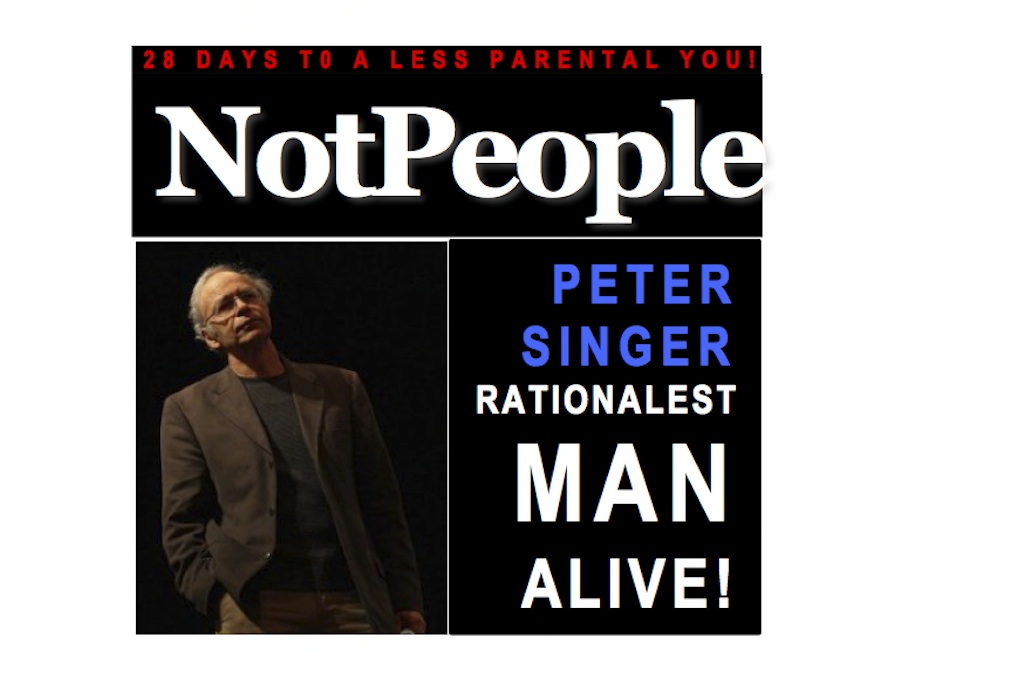
Parody People magazine cover announcing NotPeople's Rationalest Man Alive! Peter Singer

Unlike Melania Trump, Tales From the Crip plagiarizes only its own material. In honor of the Americans with Disabilities Act’s 26th anniversary, TFtC is kicking off The Year of Sassing Back, #CripLit-Style by offering this gently-used excerpt from our first — and only! — NotPeople Magazine’s Imaginary Interviews With People Who We Wish Were Imaginary. Our own Respironics Bi-Pap S/T sat down with philosopher Dr. Peter Singer, Princeton’s Ira W. DeCamp Professor of Bioethics, whose anti-crip, pro-swine agenda argues that infanticide of babies with disabilities should be legal up until the 28th day after birth, that health care for people with disabilities should be rationed, and that the consciousness of some pigs doesn’t get enough respect. Happy ADA26! We’re not dead yet!

On the Love Secrets of the Utilitarian!

RBPS/T: Isn’t “No Rules, Just Rights” pretty much the mating call of the utilitarian?

PS: “If it feels good, do it,” is a much more rational mating call.

RBPS/T: What’s a common way for a utilitarian to get friend-zoned?

PS: A utilitarian could help a hot girl move and then she gets back together with her bass-player ex. Who’s a contemporary Continental phenomenologist.

RBPS/T: That sounds…nonhypothetical. And gender-biased. But hey, you are a philosopher.

PS: JUST BECAUSE WE’RE UTILITARIANS DOESN’T MEAN WE LIKE BEING USED.

RBPS/T: Hypothetically.

PS: It was a long time ago. I am completely and 110% over it. My happiness has never been more maximized. A random person might see me on this cover and think, “Wow, he is totally living the life he said he would and here I am, possibly married to but probably long-since-dumped by an untalented string player who distracted me from what my life could have been, and if something tragic happens like I get so horribly disfigured in an accident that I need expensive but ultimately futile treatments or I have an adorable but super sick baby — which wouldn’t be so unlikely if the weak genes of a contemporary Continental phenomenologist were involved in the uterine brew — I will most definitely not want societal resources wasted on prolonging our now-useless lives that are almost entirely composed of suffering moments that don’t include one single glimpse much less the infinitely tender touch of the brilliant moral pragmatist — pragmatic moralist? — I should have appreciated and who I secretly dream of providing me with his personal care and support at no cost to the public or to his individual liberty.” SHOW ME ONE TENURED “ARTIST,” SHEILA!

RBPS/T: No projection there.

PS: What’s projection?

What #CripLit Means To Me (and How It Differs From #DisLit)

Crip Lit Let disability entertain you www.talesfromthecrip.org

Crip lit entertains you. It doesn’t explain disability.

Too basic?…

What #CripLit Means To Me (and how it differs from #DisLit) 1. In #CripLit, at least one main character has a disability and the narrator is aware of its political dimension. 2. In #CripLit, living with a disability can be described through the narrator's point of view, not just the character's, and this can provide stylistic opportunities. 3. In #CripLit, a disabled character can be deeply flawed, unlikable, or foolish, and is not obligated to be an advocate, inspiration, or role model in fictional clothing. 4. In #CripLit, an anti-hero can have a disability that is integrated into their character. 5. In #CripLit, the story does not seek to educate the reader about the mechanics of living with a disability and does seek to describe a fullness of experience, whether wholly or partially imagined. © 2016 talesfromthecripblog.com

Continue reading

Thank You, Two-Thirds of the Planet…

…for sharing “My Speech to the Graduates or What I Wish I’d Known As a 5-Year Old Crip.” It was an honor to be reblogged by you!

What do you want to contribute to that is bigger than yourself? What is it that you have to contribute?

These questions may sound like the trite stuff of a book whose central mystery is the length of its run on the best-seller list. But they matter to me because — again, as the little girl with a disability — what I heard gently murmuring in the cultural wind was: “That’s okay, don’t worry about contributing to us (the world). You’ve got enough to deal with.” Those things I care about? The writing sentences? The fairness? (Forget being President, that’s not the point.) I cared enough to know I didn’t want to be gently excused from ambition, from life, from the world’s business.

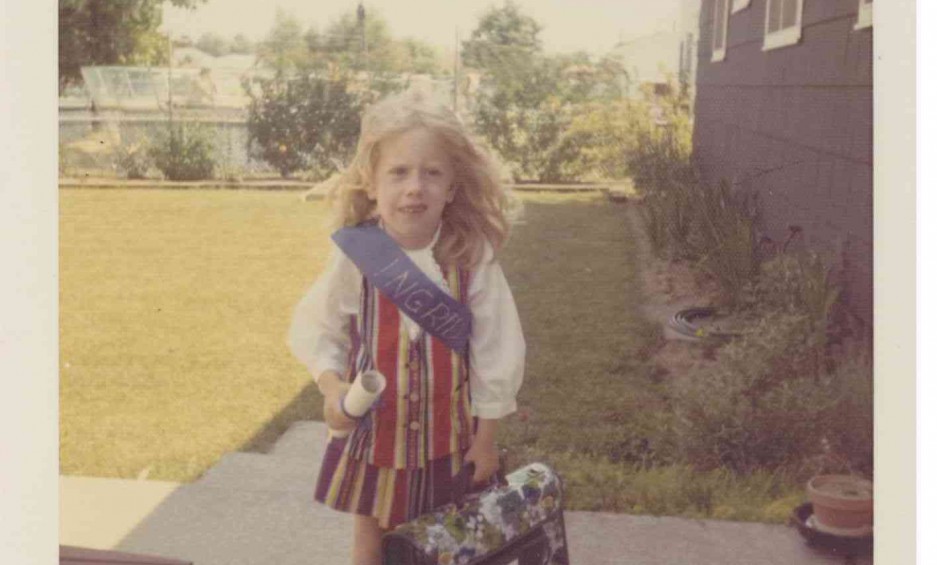
Ingrid Tischer on the day of her kindergarten graduation in Greece, New York, circa 1969. She is wearing a rainbow vest and skirt sown by her mom. Note the clutching of the diploma and school-bestowed book-bag, and anxious expression -- all indicate a future in literary fiction writing and nonprofit fundraising.

Ingrid Tischer on the day of her kindergarten graduation in Greece, New York, circa 1970. She is wearing a rainbow vest and skirt sown by her mom. Note the clutching of the diploma and school-bestowed book-bag, and anxious expression — all indicate a future in literary fiction writing and nonprofit fundraising.